
Bainbridge Island Neighbor Records
A block lookup combines geography with named public roles. City and county GIS show parcels and planning layers. Assessor Parcel Details can show taxpayer, site address, mailing address, value, and abbreviated legal description. The Auditor index connects a parcel to recorded parties. Permit and code records add dated activity. None of these sources is a live household list, so the source and its date must stay attached to every result.
| Source | What It Shows About a Block | Access |
|---|---|---|
| City and Kitsap GIS | Adjacent parcels, jurisdiction, zoning, and service context | Public maps and REST service; not title proof |
| Assessor Parcel Details | Taxpayer, site and mailing address, value, and parcel facts | Free public search; taxpayer is not occupant |
| Auditor index | Recorded parties and documents for each parcel | EagleWeb from January 1987; copies by request |
| City permit portal | Address-linked applications, status, and reviews where shown | Guest search; full files by request |
| Voter-file order | Statutory public voter fields at addresses | Affidavit and purpose limits |
| Civic organization lists | Groups active in island life, not personal members | Public listing or group contact |
The key distinction is owner versus occupant. The Assessor calls its named person the taxpayer of record and directs legal ownership questions to the Auditor. A taxpayer mailing address can be elsewhere. A deed party may have transferred an interest years ago. A permit applicant may be an agent or contractor. Use each role as a lead, never as automatic proof of who your neighbors are today.
Bainbridge Neighbor Maps by Layer
The Kitsap County GIS page links map applications, tax-property information, PDF tax maps, section drawings, contours, data layers, and a tax-account decoder. Open the parcel layer first, then add only the themes needed. The Bainbridge Island gallery lists zoning, land use, water and sewer areas, road ends, watersheds, and other planning maps. Those layers describe land and public systems, not the people using them.
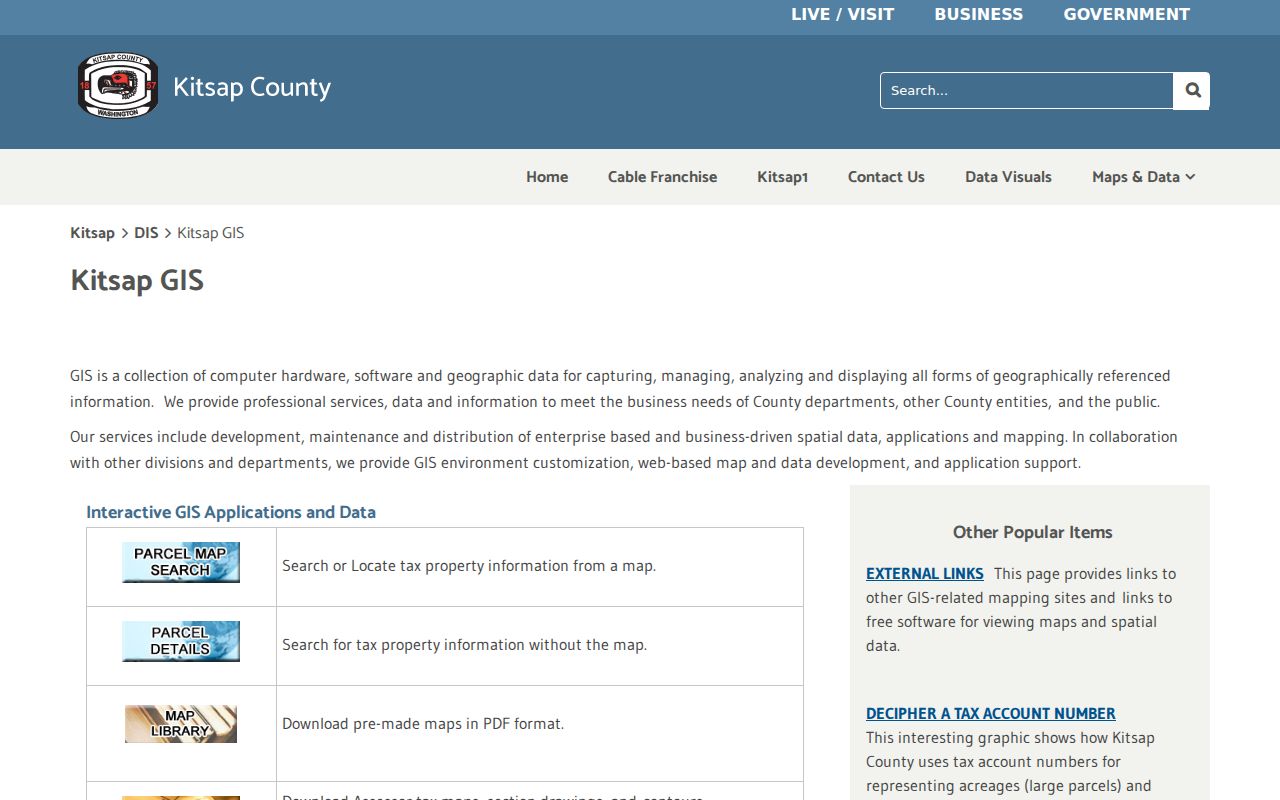
The captured county GIS page is a route into several distinct products. Follow a parcel or tax-account link to the Assessor for record details. Tax-map geometry is approximate and cannot replace a survey.
Map a Bainbridge Block Outward
The adjacent-parcel method uses a small map extent, not a mass address list. Begin at one verified public address, enable parcels, and click only the polygons touching the subject lot. The City REST service supports query, identify, and find operations and lists a 2,000-record selection setting, but that technical limit does not promise a map will show that many parcels. Keep the search to the immediate block.
- Locate the address in Kitsap or City GIS and enable the parcel layer.
- Click the subject parcel. Save its account number and abbreviated legal description.
- Click each touching parcel and follow its account link to Assessor Parcel Details.
- Compare site and mailing addresses, but do not treat a match as proof of occupancy.
- Use the Auditor separately when the question concerns recorded ownership.
This method defines neighbors by parcel adjacency. It does not imply friendship, shared household, or a fixed social boundary. For every parcel on a long road, switch to the Bainbridge Island street directory workflow rather than expanding the block search without limit.
Parcel records can disagree for sound reasons. Mapping is adjusted after plats, combinations, segregations, and other changes, while a recorded instrument and tax map serve different purposes. A vacant parcel may have no physical address. One parcel may also serve more than one entrance even though the Assessor tracks one site address. New work, spelling, or a sync delay can make an address search fail. When that happens, use the map click, parcel account, and legal-description clues instead of guessing which household belongs to the shape. For a true property-line question, the Assessor directs users to surveys and plats held through the Auditor.
Bainbridge Service Areas Shift the Block
Familiar place names do not always match record jurisdiction. The entire island’s municipal status changed in 1991, so an older file may say Kitsap County or City of Winslow where the modern address says City of Bainbridge Island. Postal city, incorporated city, county, tax parcel, service district, and historic community label belong in separate fields.
The City water and sewer page shows why. Winslow Water serves Winslow and Fletcher Bay, while the Winslow sewer area is irregular. South Island sewer serves places including Lynnwood Center, Point White, Pleasant Beach, Emerald Heights, Blakely School, and Rockaway Beach, with county Sewer District 7 treatment. Service geography can route a records question. It cannot identify a customer or resident.
Note: No official source reviewed maps every Bainbridge street to all service districts, ZIP edges, and historical community labels in one table.
Bainbridge Neighbor Voter Data Limits
VoteWA is an identity-matching portal for a voter’s own ballot and registration information. It is not a public neighbor search. A Kitsap County or state voter-file request may contain statutory public names, addresses, political jurisdiction, gender, year of birth, voting record, registration date, and registration number. Phone, email, full birth date, protected identifiers, and ballot choices are not public fields.
Kitsap orders may be made by email, in person, or fax. The county says processing can take up to three days. A requester signs an affidavit acknowledging the ban on commercial advertising and solicitation under state law. Electronic data is free, while mailed output may carry page and postage costs. These records answer whether a registration entry existed at a date, not who else formed the household.
Use less data. A block-level question rarely needs a bulk voter file. Prefer parcel facts and direct contact with a public organization.
Bainbridge Neighbors Through Civic Groups
The City’s Local Resources list names public organizations that can orient a newcomer without exposing private residents. Its categories include arts, history, downtown, farms, service clubs, environmental groups, schools, libraries, fire, and parks. A 2014 public-participation resolution names more groups, but it is a historical civic map, not proof that each group remains active.
Local Resources
Current City discovery list for civic, cultural, service, school, and environmental organizations. It does not publish member households.
Map Your Neighborhood
Preparedness tools cover readiness, damage checks, useful skills, equipment, needs, and a voluntary contact list.
Chamber Directory
Public business contacts can identify nearby services. The listings are not personal resident or neighborhood rosters.
The 2014 resolution included groups such as the Association of Bainbridge Communities, Sakai Villages Homeowner Association, Winslow Cohousing Group, Interfaith Council, Rotary, American Legion Post 172, the Japanese American Exclusion Memorial, and the Watershed Council. Verify current status before using any name. No official complete list of current neighborhood associations or public memberships was found.
The City’s Map Your Neighborhood program is a useful model for voluntary block contact. Its tools include a household inventory, readiness and damage assessments, a toolkit, and ways to note useful skills, equipment, and needs. A neighborhood contact list produced by participants is not a public resident register. Contact the program or an identified group through its public channel, and let each household decide what it shares. This approach suits Bainbridge Island neighbors better than reconstructing a private roster from parcel, voter, and business data that were collected for other purposes.
Official Bainbridge Records Versus Compilations
Commercial neighbor tools compile records from many sources, with uncertain update dates and identity matching. Official sources are narrower but publish a custodian, legal role, and record date. That makes them easier to check. Neither category should be treated as a live household census.
| Source type | Best supported use | Main limit |
|---|---|---|
| GIS and Assessor | Parcel adjacency, taxpayer, site and mailing fields | Not occupancy or surveyed title |
| Auditor and City records | Recorded parties and dated address activity | A named party may not live there |
| Commercial compilation | Possible lead for later official checks | Freshness, matching, and source role may be unclear |
Record the exact official page, access date, parcel key, and role. If two records conflict, preserve both dates and ask the office that maintains the underlying record.
Privacy for Bainbridge Island Neighbors
Private block information includes unlisted occupants, household composition, utility and delivery customers, and anyone not named in a public record. Assessor files also restrict income, senior or disabled exemption income, personal-property lists, and some privacy-sensitive data. A permit complaint is not a finding, and an old directory entry is not a current address.
Washington’s Address Confidentiality Program lets eligible participants use a substitute address. Real address, county, and precinct data are protected under state law, though older public records are not erased by enrollment. Never merge a protected voter or substitute address with an ordinary parcel occurrence.
Other gaps also matter. Public parcel data excludes or limits confidential income and personal-property information. Utility and delivery customer records are not a directory of Bainbridge Island neighbors. No official public congregation, block-watch, or civic-club membership roster was located during the research. A public officer’s name or organization address describes that person’s role, not a private home. If a City or county record seems necessary, request the smallest existing record with an exact address, department, date range, and record type. An agency may redact exempt material and does not have to create a new block report from separate databases.
Lawful use. Looking up Bainbridge Island neighbors is suitable for civic connection, reunion, property curiosity, and personal safety. Never use public records to watch, harass, threaten, or harm anyone.